Sunday, April 10, 2011

Kurram Agency and the U.S. and Pakistan's Divergent Interests


Kurram Agency and the U.S. and Pakistan's Divergent Interests
Stratfor logo

November 2, 2010 | 1214 GMT

Kurram Agency and the U.S. and Pakistan's Divergent Interests
Pakistani soldiers patrol in northwestern Kurram tribal district close to the Afghan border on July 6, 2010
Summary
Two of prominent militant leader Jalauddin Haqqani's sons have been meeting with tribal elders from Kurram agency in Peshawar and Islamabad in a bid to end Sunni-Shiite violence in northwestern Pakistan's Kurram agency. Many outside parties have an interest in what happens in the strategic region, including the Pakistani Taliban, the Afghan Taliban, Islamabad and Washington. While having the Haqqanis negotiate a settlement may be a boon to Islamabad and the Afghan Taliban, it will create challenges for the Pakistani Taliban and Washington.
Analysis
Media reports have emerged that two of important Taliban leader Jalauddin Haqqani's sons, Khalil and Ibrahim, are involved in peace talks in Pakistan's tribal belt between Sunni and Shiite leaders from Kurram agency. The talks, which have been held in Peshawar and Islamabad, represent an attempt to settle the long-running sectarian dispute in Kurram agency.
This dispute has expanded beyond localized sectarian violence into one with much further-reaching consequences involving the Pakistani and Afghan Taliban. The implications of the wider struggle encapsulate divergent U.S. and Pakistani interests in the wider region.

A Strategic Area

Kurram agency is one of seven districts in Pakistan's Federally Administered Tribal Areas (FATA). With an area of 3,380 square kilometers (about 1,300 square miles), it is the third-largest agency of the FATA after South and North Waziristan. The only area in the tribal badlands with a significant Shiite population, Kurram has a long history of sectarian violence predating the creation of Pakistan in 1947.
The area became the main staging ground for joint U.S.-Saudi-Pakistani intelligence aid for the multinational force of Islamist insurgents battling Soviet forces and the pro-Moscow regime in Kabul during the 1980s, during which time Kurram's capital, Parachinar, frequently came under attack by Soviet and Afghan aircraft. The influx of predominantly Sunni Afghan and other Islamist fighters altered the sectarian demographic balance to some extent. The Shia bitterly resisted, but Islamabad's support of Sunni locals overcame their efforts.
Kurram saw its most intense sectarian clashes only after the rise of the Pakistani Taliban phenomenon in 2006-07, however. The agency saw two weeks of violence in April 2007 as sectarian attacks spiraled out of control after a gunman opened fire on a Shiite procession in Parachinar. The violence spread all the way southeast to Sadda before the Pakistani military went in to restore order. Despite a peace agreement between the two sides that officially ended the conflict in October 2008, antagonism between the communities continued to simmer. Violence comes mostly in the form of tit-for-tat small-arms attacks carried out by tribal militias on their Sunni or Shiite neighbors.
Tribal and geographic differences reinforce the sectarian conflict. The Shia break down into three major tribes, the Turi, Bangash and Hazara. Meanwhile, eight major Sunni tribes populate most of central and lower Kurram. Sunni and Shia live in close proximity to each other throughout Kurram, which has a population of around 500,000 consisting of roughly 58 percent Sunni and 42 percent Shia.
The Sunnis' main advantage lies in control of lower Kurram. They have exploited this to close off the only major road from Parachinar, which lies on the edge of the mountains of Upper Kurram, to Thal in lower Kurram — where connections to larger markets of Peshawar and Karachi can be made. Without access to this highway, supplies have become scarce in upper Kurram.
The Shia's main advantage is control of a strategic piece of high ground that forms a peninsula of Pakistani territory jutting into Afghanistan, territory that has shifted over the centuries between Mughal, Afghan, British and Pakistani control. Upper Kurram provides powers from the east easy access to Kabul, which lies just under 100 kilometers (about 60 miles) from the border between Kurram agency and Paktia province, Afghanistan. This geographic advantage is why the CIA and Pakistan's Inter-Services Intelligence directorate decided on it as the location for training and deploying Mujahideen fighters into Afghanistan to fight the Soviets during the 1980s. It is thus key territory for anyone who wants access into eastern Afghanistan — Islamabad and the Taliban included.
The sectarian violence simmering in Kurram complicates Islamabad's efforts to defeat the Pakistani Taliban while maintaining ties with the Afghan Taliban. The violence has become a more serious threat to Islamabad's efforts in recent years, as outside forces reportedly have begun to exploit the sectarian violence. Sunni leaders in Kurram have blamed Iran for supplying weapons and cash to their Shiite rivals. While there is little evidence to back up this claim, it would make sense that Iran would want to establish a bridgehead in the Shiite population allowing it to operate in eastern Afghanistan.

The Sunni Militant Landscape in Kurram and the Afghan Angle

Well-known Pakistani jihadist Baitullah Mehsud used the base of the Tehrik-i-Taliban Pakistan (TTP) in Orakzai to expand TTP influence in Kurram. Following Baitullah's death, Mullah Toofan (aka Maulana Noor Jamal) emerged as the main TTP leader in the central rim of the FATA. Mullah Toofan now leads efforts targeting Kurram from Orakzai, which has become the main TTP hub since the Pakistani army evicted the group from South Waziristan in a late 2009-early 2010 ground offensive. Many militants subsequently resettled in Kurram.
The TTP formed alliances with the Sunni tribes in Kurram in its bid to establish a sanctuary there. The TTP later began using the sanctuary provided by allied Sunni tribes in Kurram in coordination with Orakzai and South Waziristan to conduct attacks in the core of Pakistan.
For their part, the Haqqanis want a more stable environment in Kurram. Kurram is a key piece of territory for the Haqqani network, which organizes and has sanctuaries in Pakistan's northwest from which it engages U.S., NATO and Afghan government military forces in eastern Afghanistan as part of the Afghan Taliban's eastern front.
Islamabad is very open to cooperation with the Haqqanis. They pose no direct threat to Islamabad but have the military and political clout to shape conditions on the ground in northwestern Pakistan — to say nothing of Afghanistan, where Pakistan is trying to rebuild its influence. The Haqqanis are best positioned to convince Sunnis in lower Kurram to open up the road to Parachinar and to restrain Shiite forces from attacking Sunnis (and vice versa). The easing of sectarian tensions, likely if this happens, would hamper the TTP's ability to grow in Kurram, satisfying Islamabad's goal in the agency.
If the Haqqanis can successfully negotiate a peace in Kurram (or at least a cease-fire — Kurram's geopolitical and sectarian rivalries will not simply vanish) it would give them a stronger foothold in an area close to Kabul and eastern Afghanistan. This arrangement would not bode well for security in eastern Afghanistan, where U.S. and coalition forces are concentrating much of their efforts in their current offensive against the Taliban and al Qaeda.
This would come at a bad time for Washington, which is looking to contain the Afghan Taliban as it seeks to bolster the U.S. negotiating position ahead of eventual talks regarding a U.S. withdrawal from Afghanistan.
The Kurram sectarian conflict is also the most prominent example of Islamabad trying to eliminate "bad" Taliban while supporting "good" Taliban. Preventing sectarian violence in Kurram from spiraling out of control and benefiting the TTP requires that Islamabad seek the services of the Haqqanis. This also will help Pakistan's longer-term efforts to re-establish its influence in Afghanistan after the withdrawal of U.S.-led forces. Kurram thus encapsulates the larger challenges Washington faces in containing a militant movement that enjoys Islamabad's tacit support.


Saturday, April 9, 2011

Imran Khan to protest against drone strike

The Express Tribune
Imran Khan confirmed that the protest will be held on April 23 and 24. PHOTO: FILE
Pakistan Tehrik-e-Insaaf  (PTI) Chief Imran Khan has said on Thursday that he would stage a two-day protest on the Pak-Afghan highway in Peshawar against US Drone strikes and NATO supply.
Speaking at a press conference, Imran Khan confirmed that the protest will be held on April 23 and 24.
Imran condemned the drone strikes and said it is about time action was taken against them
He also stated that this protest would be the first step towards taking a stand against drone strikes.
PTI Chief has urged people from all walks to unite in order to stop NATO supplies and drone strikes in the country.
Talking about the upcoming elections, he said that the Supreme Court must ensure free and fair elections and suggested that the voter's picture should be displayed on the lists as well.
 

Militant illusions


The Express Tribune

Militant illusions

Published: April 7, 2011
The strategy used by the Pakistan military of clearing specific areas and then marching on has been criticised at home too.
Have we been living for the past two years in the shadowy world of illusions, where nothing is quite what it seems? Since 2009, when thewar against the Taliban got underway in earnest, we have been told of decisive victories in Swat, in Bajaur and South Waziristan. Suspicions that these military projections seemed rather too optimistic given the continued acts of terrorism and the hold of insurgents on areas such as the Kurram Agency, have been confirmed by a bitingWhite House report to Congress. It states that Pakistan still lacks a "clear path" to defeating insurgents and that the situation had deteriorated in recent months. In what seems like a knee-jerk reaction, Pakistani officials are reported to have denied the veracity of the report.
But perhaps rather than refusing to hear things we do not like, we should listen a little more carefully. While pointing to the immense sacrifices made by Pakistan in the war on terror, the report also mentions good cooperation between Washington and Islamabad. It can then hardly be described as being biased or intended to damage Pakistan. This makes it all the more necessary to tune in to the criticisms it makes — notably the lack of "build" and "hold" operations.
The strategy used by the Pakistan military of clearing specific areas and then marching on has been criticised at home too, on the grounds that it gives the Taliban an opportunity to retreat, and then regroup and return or reassemble in other locations. The army, which is conducting what now seems to be an unending war, needs to look at this and decide if a change in plan is needed. The report is not encouraging but it can be used as one basis on which to reassess what is happening in tribal areas and determine if the war is genuinely being won or whether this is just an illusion that is intended to fool us as civilians and disguise the fact that the militants are proving far more impervious than had seemed when the operation against them began.

ANALYSIS: IDP children’s right to education —Farhat Taj


Daily Times
Saturday, April 09, 2011
ANALYSIS: IDP children's right to education —Farhat Taj

True, families all over Pakistan find it increasingly difficult to spend on children's education due to the rising inflation in the country. The FATA displaced families are a different case though. This case is directly linked with the ongoing security situation in the country 


Military operations in the Federally Administered Tribal Areas (FATA) and the Taliban atrocities in the area have displaced hundreds of thousands of people. This has led to multiple human rights violation of the internally displaced persons (IDPs), including the IDP children's right to education. I came across hundreds of IDP children who were earlier in schools in FATA but have now ended up in child labour due their families' economic hardships caused by the displacement or their families struggle very hard to keep them in schools and colleges in the places where they now live as IDPs.

Bilal, an IDP from Parachinar, is in 7th grade in school. His father, Muhammad Jan, recently died of a kidney ailment that he could not afford to get treated due to economic constraints caused by the displacement. He was an automobile mechanic linked with the office of the political agent, Kurram. Bilal has four sisters and his mother, an illiterate housewife, now does not know how to keep her children in school without any source of earning. The family needs a sustainable source of income for subsistence in the displacement. The family has received no financial assistance from the Kurram political administration that Bilal's father served for 15 years as an automobile mechanic.

Ahmed, an old displaced school student, is brother of a Taliban foot soldier who died in a US drone attack. His mother is terrified. She does not want to see Ahmed ending up with the Taliban. She wants him to study and live a normal, peaceful life as an educated man. The family is under intense financial constraints and needs help to keep Ahmed in school.

Zenaba, another IDP woman, has a daughter who is in college and needs financial help to keep her in college. Her husband is unable to earn or even live a normal life due to unstable mental health for several years. This tribal woman, Zenaba, is determined that her daughter must get higher education to be able to earn for herself.

There are many other countless stories of the IDP families from FATA who need help for their children's education. The government has ignored such families' plight to date. A case in point is the complaint of the Parachinar Reform Committee (PRC), a committee formed by the IDPs from Parachinar now based in Kohat since their displacement in 2007. Attaullah Khan, spokesman of the PRC, informs that there are about 110 students among the Parachinar IDPs who need immediate financial support to continue their education. Several of those students work after school time but this makes no significant contribution in easing the economic constraints of their displaced families. The PRC committee has been requesting the FATA education authorities as well as political administration of Kurram for years to provide monthly stipends to the needy displaced students but to no avail. Attaullah Khan as well as internally displaced parents who I met argue that the political administrations in FATA have hefty sums of money at their disposal and it would not make much difference to them if some of the money is spent to support the IDP families who want to keep children in educational institutions despite the sufferings caused by displacement. They wonder where does all the money go that comes to Pakistan from international donors in the name of FATA. The money is certainly not reaching the most needy people of the area.

True, families all over Pakistan find it increasingly difficult to spend on children's education due to the rising inflation in the country. The FATA displaced families are a different case though. This case is directly linked with the ongoing security situation in the country. They have been rendered homeless by the state in pursuit of some state agenda that led to the current security crisis in FATA. It is now the responsibility of the state to bring some normalcy in the displaced people's lives, including direct financial support to the IDPs' families with children in educational institutions. This is especially important for families like Ahmed's who may have a history with the Taliban but are now determined to break away from that history for good. The internally displaced families determined on girls' education need to be especially helped in terms of financial support since widespread women's education is necessary for FATA to counter the extremist propaganda from the right-wing religious parties, the only political forces legally allowed to operate in FATA through mosques and madrassas.

Sunni and Shia IDPs from Kurram deserve special government support in the context of the sectarian tension in this Agency and elsewhere in Pakistan. To prevent children and young people on both sides from falling into the hands of sectarian militant groups, the government must go an extra mile to facilitate their access to education through stipends to every Shia and Sunni IDP student. Several Sunni tribal leaders inform that anti-Shia militant groups approach them to offer financial help in return for a certain number of young men for recruitment in the groups. The tribal leaders say they have been politely refusing such offers because they do not want their future generation to be consumed by the sectarian fire that has already disrupted their present. They, however, express the concern that it may be increasingly difficult for them to control all young people, who are frustrated by the sufferings caused by displacement and the government's failure to restore the writ of the state in Kurram.

Education is the right of every child and besides the government, the larger Pakhtun civil society also has a responsibility to help in this regard. I have not seen any substantial efforts coming from Pakhtun civil society. Take, for example, the two Pakhtun nationalist political parties, the Awami National Party (ANP) and Pakhtunkhwa Milli Awami Party (PkMAP). True that the two parties are under pressure from the intelligence agencies of Pakistan, but that does not mean they cannot do anything to effect some change in their biggest bone of contention with the ISI — FATA and its use as strategic space for control over Afghanistan.

A tribal leader from Kurram informs that once he told Asfandyar Wali Khan, the ANP leader, that his party must stop raising slogans of Pakhtun nationalism if the party has nothing to offer the FATA IDPs. The tribal leader has a point. There are so many rich people in the ANP and PkMAP. Why cannot they quietly reach out to the IDPs' families to support their children's education with donations? I have not seen any evidence of the ISI pressure stopping them from doing that. The avowed Pakhtun nationalists have disappointed the IDPs, just like the state authority responsible for FATA, the federal government of Pakistan.


The writer is a PhD Research Fellow with the University of Oslo and currently writing a book, Taliban and Anti-Taliban
 

Friday, April 8, 2011

Deployment of soldiers on Kurram roads urged

PARACHINAR: The ulema and tribal elders in restive Kurram Agency have asked the government to deploy the army on the roads to protect lives of the passengers and announce support package for the 0.5 million tribal people who were stranded due to the insecure roads.

Addressing a press conference here Thursday, the ulema and elders including Allama Muhammad Ibrahim Muhammadi, Allama Muhammad Hussain Tahriri, Muhammad Taqi and others said the people of the Kurram Agency were economically paralysed by a handful of militants in the area. They added that the government along with the military high-ups must realise the social and economic plight of the residents of Kurram tribal region.

They wondered as to why the civil and military leadership were shy in taking concrete steps against the group of militants entrenched in the lower parts of Kurram Agency.

They said it was high time the government must stop the bloodbath in Kurram Agency that had been enforced on the residents in the area for the last four years. The elders said that there were elements, which were instigating the already hurt Turi and Bangash tribes to stage a revolt against the government that was unable to protect the lives of the people including women and children. They asked the government to recover forthwith more than 35 passengers abducted by militants on March 25 while they were on way to Parachinar.
 

Thursday, April 7, 2011

Action demanded against Kurram deal


Our correspondent
Thursday, April 07, 2011
 
PARACHINAR: The Turi and Bangash elders in upper tehsil of Kurram Agency on Wednesday asked the grand jirga, which had brokered the peace accord, to take action against the violators of the agreement.

Addressing a jirga of the two tribes on Wednesday, the elders including Yousaf Turi, Shabbir Bangash and others said if the political administration, elders of both the sects forming the grand jirga and the government failed to address their concerns, they would take action against the violators of the peace deal on their own.

They said 40 passengers kidnapped by militants were still untraced while 16 were killed and 24 others injured in the recent spate of violence against the passengers on Parachinar-Sadda-Thall Road.

They asked the Khyber Pakhtunkhwa governor and the federal government to take decisive steps against militancy in the area as Kurram Agency was bleeding for the last four years and the government was guilty of criminal negligence for failing to establish peace in the area.

Wednesday, April 6, 2011

2 militants die as groups clash in Kurram Agency

Wednesday, April 06, 2011
 

HANGU: Two militants were killed and two others sustained injuries in a clash between two groups of militants in Bagan area of Kurram Agency, official and local sources said on Tuesday. 

The sources said that Commander Noor Muhammad and a militant Fazal Mehmood, belonging to Masozai tribe, were on their way to Sadda from Bagan in a pickup truck when their vehicle was ambushed by militants from rival Commander Noor Jamal alias Mulla Toofan group on Jharali Road in the lower Kurram valley. 

The sources said that Commander Noor Muhammad and his lieutenant Fazal Mehmood were killed and two other militants sustained injuries in the clash. Noor Jamal group and militants belonging to the Masozai tribe had been fighting to secure the leadership of the Tehrik-e-Taliban Pakistan in Kurram for the last several months
 

No peace in Kurram

No peace in Kurram

By Hasan Khan | From the Newspaper
THE government of Pakistan and its strategic planners in the security establishment do not appear interested in peace in the strategically important Kurram tribal agency. This is the popular perception among the region's Shias and Sunnis after the eruption of a fresh wave of violence.
The views seem to be grounded in reality, otherwise the government would not so easily have squandered the opportunity for peace after the warring sects signed a peace accord on Feb 3.
The tribal elders from other regions of Fata, who were part of the grand tribal jirga that succeeded in formulating the peace accord, are also questioning the government's failure to exploit the chance to bring lasting peace to this violence-prone region. The crucial issue for everybody, whether Shia, Sunni or tribal elder, is the government's failure to secure the Thall-Parachinar highway so that the residents of upper, lower and central Kurram can commute freely.
The Thall-Parachinar road is the lifeline of the Kurram Agency, and the jirga earnestly urged the government to secure this road by increasing the number of check posts, particularly at places such as Chappari, Mandori, Ochatt, Baggan and Alizai where both Shias and Sunnis are being killed or kidnapped. At the time the peace accord was signed in Islamabad, Interior Minister Rehman Malik assured the jirga that the government would re-establish its surrendered writ in Kurram Agency.
Following the truce, peace seemed to be achievable. Unbelievably, however, both the government and the security forces wasted this opportunity very early. Arriving at a peace agreement between Shias and Sunnis took years of hectic efforts by the grand jirga. Economic losses aside, violence in the region had already extracted a heavy toll, killing more than 2,000 and injuring another 4,000 people, with hundreds of thousands more displaced.
Shias and Sunnis showed excitement in welcoming the jirga elders at Chappari post — the entry to Kurram Agency — on Feb 3. This marked the symbolic opening of the Thall-Parachinar road that has remained closed for years. The celebration at Chappari was replicated at other places by Shias and Sunnis jointly, negating the idea that Shias and Sunnis were killing each other for faith-based reasons.
Local militants also jumped on the peace bandwagon. The Tehrik-i-Taliban Pakistan (TTP) Kurram commander, Fazal Saeed, extended support to the accord and warned that in case of any violations, the TTP would first ask the political administration and jirga to take action, and failing that would consider itself justified in punishing the side violating the agreement.
There was also the impression that Afghan Taliban leader Siraj Haqqani was instrumental in bringing the warring sects to the negotiation table. The militant group, which perceived Shias as heretics, asked the Shias of upper and lower Kurram to use the roads, including the vital Thall-Parachinar road, without fear. Many believed that the TTP was expecting windfall benefits from the accord.
Come March 5 and the accord was violated. On March 13, there was another violation at Mamo Khwar of tehsil Thall when militants killed 11 passengers and left several others injured. On March 25, yet another convoy was attacked and 13 passengers were killed, eight were injured and another 45 were abducted by suspected militants in the Baggan area.
The government acted as a spectator. The abduction of 45 people is not a single man's job, yet the abducted and their abductors managed to vanish into thin air. Locals believe that this could not have happened without the connivance of the government and the security forces.
The fundamental questions remain unanswered: why did the militants retaliate so early and why have the government and the security forces maintained such a criminal silence? A senior member of the jirga confided that in order to elicit the support of the TTP Kurram commander, Fazal Saeed, for the accord, the government tacitly agreed to release one of his close relatives and allow his petrol pump businesses to be reopened. Honouring this commitment has been delayed for unknown reasons.
The militants were also expecting more benefits, particularly from the Shias of upper Kurram, in return for promising them safe passage on the Thall-Parachinar road. They wanted the Shias to allow safe passage to militants into the areas in Afghanistan known as the Khost Bowl and up in the north in Tora Bora. Taliban commander Siraj Haqqani's forces are operating primarily out of the Khost Bowl, including Paktika, Paktia and Khost.
Shias are in the majority in upper Kurram with access to all the strategic routes, including the Malikili-Kharlachi route, the Parachinar-Terimangal route leading to the Khost Bowl and the third route leading to Tora Bora via Zairan and Malanah.
Those keeping an eye on the conflict across the Durand Line believe that the Nato/US announcement regarding the withdrawal of troops has also put regional powers in a new situation. These regional powers — particularly Pakistan — have started preparing for the post-2014 Afghanistan.
The Kurram tribal agency is highly prone to violence in the name of sectarianism, and this phenomenon has been used during the prolonged Afghan conflict by those playing double games. It constitutes strategic ground for the militants and is called the 'parrot beak', going deep into Afghanistan and thus providing militants easy access to areas such as the Khost Bowl.
It is acknowledged that some quarters in Pakistan's security establishment are still sticking to the infamous 'strategic depth' policy in Afghanistan. In the emerging Afghan scenario, the reclusive Taliban leader Mullah Muhammad Omar does not dance to the tune of the Pakistani establishment. And instead of banking all out on Omar, 'strategic depth' proponents are keeping the Haqqani card — an influential Taliban commander in the south and southeast of Afghanistan — very close to their chest.
Easy access to the Khost Bowl is the top priority of the Pakistani security establishment, and upper Kurram, dominated by Shias, has all the access routes. If supported by the Shia population, not only will militants have more space in Pakistan's tribal territories, it would also provide easier access to Khost Bowl for others fighting the US/Nato forces.
Many believe that the Shia community's denial of benefits to militants and the Taliban led to the government using delaying tactics in taking action against those who violated the accord. The government also delayed the resettlement, as per the agreement, of thousands of displaced families, both Shia and Sunni, as it kept waiting for cooperation from the Shias.
The writer is the director of news and current affairs at Khyber TV.
 

Why Are Peace Deals So Difficult To Keep In Pakistan's Tribal Areas?


FEATURES

Why Are Peace Deals So Difficult To Keep In Pakistan's Tribal Areas?

In March, Kurram elders spread carpets on the snow and listened to poetry competitions in which poets rejecting the extreme way to Islam sang odes to peace.
April 05, 2011
By Majeed BabarCharles Recknagel
It doesn't take much to undermine a peace accord in Pakistan's tribal area.

The most recent example is the peace deal in Kurram Agency, which has a long history of Shi'ite and Sunni sectarian conflicts now compounded by the presence of extremist Sunni Taliban.

Tribal elders have invested hours of negotiations to bring the agency's warring parties to the peace table and end sectarian clashes that have sent hundreds of thousands of people fleeing into camps for internally displaced persons (IDPs) in other parts of Pakistan.

A key part of the deal has been promises of millions of dollars of compensation for those who have lost their relatives, property, or possessions in the upheavals. The promises have convinced many IDPs to return home and try to make a new start.

In March, the efforts seemed to have finally created a durable peace deal. Many villages celebrated with cultural events that gathered rival leaders peacefully together for the first time in years. Elders spread carpets on the snow and listened to poetry competitions in which poets rejecting the extreme way to Islam sang odes to peace.

"I don't need paradise, [and angels] but I need torches of light to dispel this darkness," said one poet, Yousaf Maranj, refuting Taliban promises to young men that suicide bombing will give them instant entry to paradise.

Broken Peace

But now this carefully crafted accord appears to be in jeopardy over incidents whose small scale only illustrates the enormity of the task of maintaining any peace for long in this volatile region.

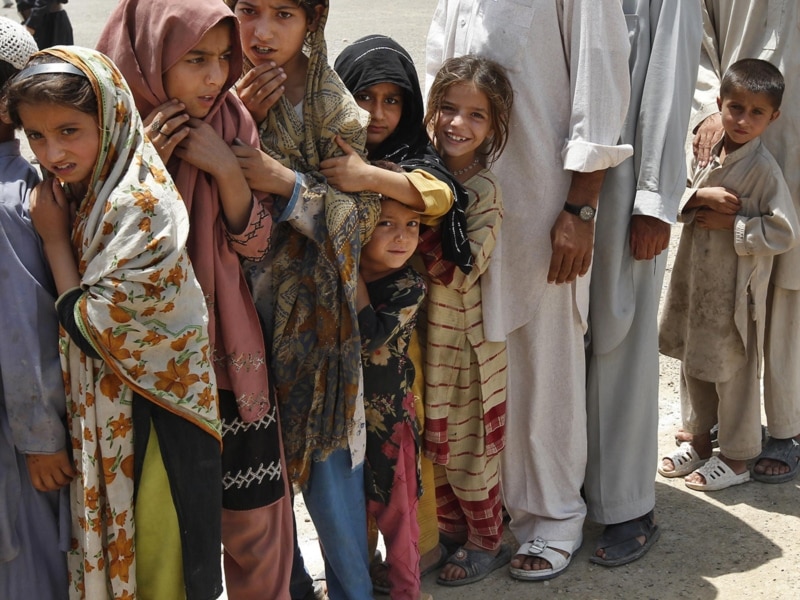
Displaced children wait for aid at a distribution center in Sadda in Kurram Agency in July 2010.
Most recently, 12 gunmen opened fire on a caravan of three vehicles carrying members of a Shi'ite tribe from Peshawar to the Kurram Agency city of Parachinar. The ambush, near the city of Bagan, killed eight people on the spot and wounded five others who died later in hospital. 

The gunmen locked up the remaining 35 passengers in two of the coaches and disappeared with them. Since then they have released just seven people -- all women and children -- while holding the others hostage in an unknown location.

Shi'ite tribal leaders in Kurram say they know the identity of the attackers and their motives. "Everybody feels sorry, but nobody is telling the truth," says Sajid Hussain Turi, a parliament deputy from the Kurram tribal area. 

"The truth is that militants, the Taliban, the groups belonging to Hakimullah Mehsud, Fazal Said Haqqani, and Mullah Noor -- all of them are responsible for the failure of this truce," Turi tells RFE/RL's Radio Mashaal. "The government knows them and is in a position to start operations against them, but the security forces are not willing to root them out, and we don't know why."

Exacerbating Divisions

To many, the Taliban is the most likely suspect for two reasons. First, those killed belonged to the Turi tribe in the Kurram region, whose people have blocked Taliban militants from using their territory to cross into Afghanistan. Second, it is the Taliban that currently stands the most to gain from the chronic outbreaks of communal violence in Kurram. 

Over recent months, the Taliban has increasingly moved into Kurram to avoid drone attacks in their strongholds of North and South Waziristan. At the same time, Kurram has become a key Taliban corridor for shuttling fighters and material from bases in central Orakzai district to attack the NATO supply lines that move through the Khyber Pass to Afghanistan. 

The Kurram tribal area has sectarian tensions that predate the Taliban but the Taliban has proved particularly effective at stoking them for its own ends. 

Decades ago, Sunni and Shi'a lived side-by-side peacefully but this began to break down in the 1980s when former Pakistani dictator Muhammad Zia ul-Haq began allowing ethnic- and sectarian-based political parties. This made it easier for him to control a divided society but resulted in the forming of militant groups that attacked each other and secular figures.

For decades, Kurram Agency seemed generally resistant to such sectarian violence except for security alerts during the annual observance of Ashura, when Shi'ite faithful hold public processions. Instead, the feuding took such forms as sectarian rivalries to build the tallest minarets. But with arrival of the Taliban after the September 11, 2001, attacks in the United States, the rivalries turned lethal.

Central Government Failure


Today, the main cities of Kurram Agency have seen the majority sect chase out the minority one, not only creating IDPs but also a siege mentality on both sides. The Sunnis control the main highway over which supplies move to all parts of Kurram and periodically ambush buses carrying Shi'a. The Shi'a, in turn, divert water that passes through their territories so it does not reach the Sunni areas.


By law, the Pakistan government is responsible for keeping roads in the tribal areas open and for assuring that resources are shared. But while Islamabad was able to do so with the support of tribal leaders when tribal society was intact, it finds it hard to do so today, even with military deployments. Since 2006, more than 937 tribal leaders have been targeted and killed both by the Taliban and by Pakistani intelligence agencies across the tribal areas, shattering the region's traditional social structures. 

In an effort to push the government to act, the Shi'ite community decided after last month's ambush near Bagan to launch a "social boycott" of Islamabad. The Turi tribe said it would withhold payments on utilities until the attackers were caught and the hostages freed. "We decided that we will not have any links and business with the government, until our hostages are freed," parliament deputy Turi says.

Promises Not Kept


Still, the failure to arrest the attackers is not the only thing people in Kurram see as Islamabad's lack of support for the peace accord.

Equally problematic is the government's slowness to deliver on its promises of financial compensation for victims of past violence in Kurram Agency. Many local leaders were able to argue successfully for peace by convincing more combative followers that there would be clear and immediate economic awards. 

The government of Prime Minister Yousaf Raza Gilani promised up to 1.5 billion rupees (some $17.5 million) to help the rehabilitation of displaced persons -- both Shi'ite and Sunni. The compensation process was to have begun on March 5. 

Weeks later, the money has yet to be delivered. "They need to build their homes and those who lost their loved ones have to be paid, and so do those who have been injured," says Malik Waris Khan Afridi, chief of the Grand Jirga of Peace for Kurram. "Only then will the local people trust the jirga and believe that the truce is working."

Afridi adds that the government has now promised that the money will be paid in the next few days but that it has yet to provide any explanation for its delays.

Meanwhile, the newly appointed governor of Khyber Pakhtunkhwa Province, Masud Kausar, who is also responsible for all of the tribal area, says the roads in Kurram Agency are well secured, despite the recent ambush. He said last week that he would soon drive to Kurram to show the roads were open.

The question now is whether Islamabad can move quickly enough to provide its promised support before further outbreaks of tension undermine its ability to still rescue the peace deal. Prior to the accord, violence in Kurram reached levels that Islamabad was only barely able to rein in.