Friday, March 13, 2009

Drone Strike Kills 21 in Pakistan . NY TIMES


Friday, March 13, 2009 Last Update: 8:00 AM ET


Drone Strike Kills 21 in Pakistan 
 
Published: March 13, 2009


ISLAMABAD —

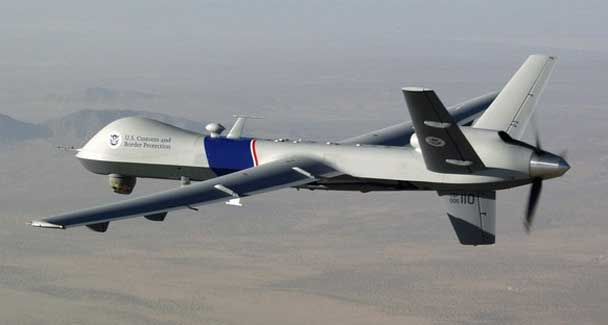
Three missiles thought to have been fired from remotely piloted American aircraft struck a Taliban training camp in the Kurram area of northwestern Pakistan late on Thursday and killed 21 militants, according to a local government official and news reports on Friday.

Nine other people were injured in the strike around 9.30 p.m. to 10 p.m., directed at a training camp some 20 miles from Parachinar, the capital of the remote tribal area where 31 people were killed in a similar attack on Feb. 16. of Kurram Agency, according to the official, who spoke in return for anonymity because he was not authorized to speak to reporters.

The camp was under the command of Fazal Saeed, a local militant commander aligned with Baitullah Mehsud who heads a militant network seeking to topple the beleaguered Pakistan government. The attacks on Mr. Mehsud's camps over the past month represent an expansion by the Obama administration of the covert war run by the Central Intelligence Agency, carried out largely by drone aircraft.

Under President Bush, the United States frequently attacked militants from Al Qaeda and the Taliban involved in cross-border attacks into Afghanistan, but had stopped short of raids aimed at Mr. Mehsud and his followers, who have played less of a direct role in attacks on American troops.

Residents and officials in Kurram said on Friday that they see drones flying over the area most days, including on Thursday before the attack in a remote and inaccessible area. The official said it would take some time to evaluate the full impact of the attack.

More than 30 drone strikes have been reported since last September.

The two attacks on camps run by Mr. Mehsud follow his decision to unite with two other militant commanders last month to launch joint attacks against NATO and American forces in Afghanistan.

The Obama administration has announced plans to send 17,000 additional troops to Afghanistan, where militants fighting allied troops include those based in Pakistan's remote and lawless tribal areas.

The drone strikes are deeply unpopular with many Pakistanis. Some of the attacks have killed civilians, enraging Pakistanis and making it harder for the country's shaky government to win support for its own military operations against Taliban guerrillas in the country's lawless border region.

The strikes may also be pushing the Taliban, and some Al Qaeda elements, out of the tribal belt into areas such as the Swat valley, where the government recently struck a truce with the Taliban.


 SOURCE: http://www.nytimes.com/2009/03/14/world/asia/14drone.html?ref=world


Subscribe to parachinar616
 

Powered by us.groups.yahoo.com


Deaths in Pakistan drone strike , aljazeera

UPDATED ON:
Friday, March 13, 2009
11:27 Mecca time, 08:27 GMT


Deaths in Pakistan drone strike

At least 18 people in Pakistan, including suspected al-Qaeda fighters, have been killed in a missile attack thought to have been carried out by an unmanned US drone.

Security officials said the raid targeted a Taliban camp in northwest Pakistan on Thursday.

Two missiles fired by a drone hit the alleged camp in the tribal area of Kurram, one of seven semi-autonomous regions near Pakistan's border with Afghanistan.

A senior security official,  speaking anonymously, said: "Twelve militants, mainly Afghan Taliban, were killed in the missile strike at their training centre in Kurram. Dozens are wounded.

"The training centre was run by local Taliban commander Fazal Saeed and training was under way at the time of the strike."

The Taliban has sealed off the area and was retrieving bodies from the rubble of the building, officials said.

Kurram is a known hub for fighters loyal to Baitullah Mehsud, Pakistan's most wanted man, and Sirauddin Haqqani, de facto commander of Taliban-aligned groups on the border.

Security officials had earlier said that at least seven fighters had been killed in the attack, including "foreigners" - using a term adopted to mean al-Qaeda operatives.

Repeated strikes

More than 30 such missile attacks have been carried out since August 2008, one month before Asif Ali Zardari was sworn into office as president of Pakistan, killing more than 320 people.

The US military does not confirm drone attacks, but it and the Central Intelligence Agency operating in Afghanistan are the only forces to deploy drones in the region.

It was the fifth missile attack blamed on unmanned US aircraft since Barack Obama, the US president, came to power, dashing the Pakistani public's hopes that the new administration would abandon the policy.

Obama says fighters in Pakistan and Afghanistan, where US troops are battling the Taliban, pose a grave threat.

Islamabad has repeatedly protested to Washington that drones violate its territorial sovereignty and deepen resentment among the 160 million people of the nuclear-armed Islamic nation.


SOURCE: http://english.aljazeera.net/news/asia/2009/03/200931218510270742.html


Click to join parachinar616

Click to join

parachinar616


Subscribe to parachinar616
 

Powered by us.groups.yahoo.com


US missile strikes kill 14 in Kurram Agency


 GEO Pakistan
 US missile strikes kill 14 in Kurram Agency
 Updated at: 2216 PST,  Thursday, March 12, 2009
US missile strikes kill 14 in Kurram Agency KURRAM AGENCY: At least 14 people were killed Thursday in suspected US missile strikes in Kurram Agency.

According to eyewitnesses, US drones fired four missiles on a residential building situated in Barjo area of Kurram Agency, killing at least 14 people.

Sources said that some foreigners were also among the dead. However, it was yet unconfirmed.


SOURCE: http://www.geo.tv/3-12-2009/37165.htm


Visit

www.parachinar616.blogspot.com


Death toll from drone attack in NWFP rises to 24


SOTT.net


Pakistan: 10 killed in US missle attack

Hussain Khan
Dawn
Thu, 12 Mar 2009 21:48 UTC

US drone
© Reuters/File photo
Drone attacks have continued despite official government protests
 
A suspected US drone targeted a militant hideout in Berju area of Central Kurram tribal region on Thursday evening, officials said. According to unconfirmed reports 10 people had been killed in the attack.

Political Agent Arshad Majeed said that missiles had been fired in Central Kurram, but did not give details about casualties. He told Dawn in Parachinar, the regional headquarters, that four to five missiles were fired in the area.

This was the second drone attack in Kurram tribal region. Two missiles were fired at a suspected compound in Ahmadi Shama village in Lower Kurram on February 16 which resulted in 30 casualties.

Local people said that missiles hit suspected hideouts in Berju, some 80 kilometers east of Parachinar city. The area, they said, was a hub of local and foreign militants. Sources said that local people had started an operation to retrieve bodies and rescue the wounded.

Militants have sufficient concentration in lower and central Kurram which has been encircled by Afghanistan from three sides. Residents said that spy planes were hovering over the area and believed that missiles were fired from a drone.

======================================

ChennaiOnline

Mar 12, 2009

Islamabad, Mar 12 At least seven persons were killed in missile strikes carried out by a US drone in Pakistan's Kurram tribal region today.
The US drone fired at least four missiles at a home in a village in Kurram agency, official sources were quoted by TV channels as saying.

There was no official word on the casualties though TV channels and witnesses said seven persons were killed in the attack.

Kurram agency was in the news recently for intense sectarian clashes between Shia and Sunni tribesmen that killed hundreds of people.

There were reports of Taliban militants infiltrating the area to back the Sunni tribesmen.

The US has not stopped drone attacks in Pakistan's tribal belt despite Islamabad's protests that such strikes are counter-productive and a violation of the country's sovereignty. There have been more than six drone attacks since US President Barack Obama assumed office. (Agencies)


SOURCE: http://news.chennaionline.com/newsitem.aspx?NEWSID=88debbd6-da2e-48b7-861d-e681d3af4d19&CATEGORYNAME=INTER


===========================================================

US missile strike in Kurram agency levels Taliban training camp

The US targeted a Taliban compound in a cross-border strike into Pakistan's tribal areas today. The strike took place in the Kurram tribal agency and was the second attack there since December 2008.

The Predator airstrike hit a Taliban compound and training camp in the Barjo region in Kurram. "The training camp was completely destroyed," a villager told Reuters. At least four Hellfire missiles were reported to have been fired at the camp.

Unconfirmed reports indicate up to 14 people, including "foreigners," were reported killed in the attack. The term "foreigners" is often used to describe al Qaeda operatives sheltering in Pakistan's tribal areas. No senior al Qaeda or Taliban leaders have been reported at this time.

Today's attack is the first since March 1, when Predators targeted a Taliban compound in a region of South Waziristan controlled by Pakistani Taliban leader Baitullah Mehsud.

The first US attack in Kurram took place on Feb. 16 of this year. More than 30 people, including Arab al Qaeda fighters, were reported killed in the attack.

Previous airstrikes have focused on Taliban and al Qaeda training camps and safe houses in the tribal agencies of Bajaur and North and South Waziristan. One other strike hit a Taliban camp in the settled district of Bannu in the Northwest Frontier Province.

The Taliban have expanded their control into Kurram by backing the wave of sectarian fighting between Sunni and Shia in the region. The Shia have been forced into small enclaves in Parachinar and other areas as the Pakistani military has refused to come to their aid.

The Taliban have used Kurram as a training ground for their forces and have established several bases in the agency, an intelligence official familiar with the situation in Pakistan's tribal areas told The Long War Journal on the condition of anonymity.


HAKEEM%20ULLAH%20MAHSUD-web-version.JPG

Taliban commander Hakeemullah Mehsud is behind the attacks on NATO convoys in Khyber and Peshawar. Photo provided to The Long War Journal by Bill Longley..


The Taliban in Kurram are led by Hakeemullah Mehsud, a rising star in the Pakistani Taliban. Hakeemullah is a senior lieutenant and cousin of Pakistani Taliban leader Baitullah Mehsud; he is also a cousin of Qari Hussain Mehsud, the notorious Taliban commander who trains child suicide bombers in South Waziristan.

Hakeemullah has been leading operations against NATO's supply lines in Khyber and Peshawar. He also commands the Taliban in the Arakzai and Khyber tribal agencies.

Background on US strikes against al Qaeda and Taliban networks in northwestern Pakistan


Click map for full view.
Taliban presence, by district and tribal agency, the Northwest Frontier Province and the Federally Administered Tribal Agencies. Information on Taliban presence obtained from open source and derived by The Long War Journal based on the presence of Taliban shadow governments, levels of fighting, and reports from the region. Map created by Bill Raymond for The Long War Journal.


US intelligence believes al Qaeda has reconstituted its external operations network in Pakistan's lawless, Taliban-controlled tribal areas. This network is tasked with hitting targets in the West, India, and elsewhere. The US has struck at these external cells using unmanned Predator aircraft and other means in an effort to disrupt al Qaeda's external network and decapitate the leadership. The US has also targeted al Qaeda-linked Taliban fighters operating in Afghanistan, particularly the notorious Haqqani Network.

As of last summer, al Qaeda and the Taliban operated 157 known training camps. Al Qaeda has been training terrorists holding Western passports to conduct attacks, US intelligence officials have told The Long War Journal. Some of the camps are devoted to training the Taliban's military arm, some train suicide bombers for attacks in Pakistan and Afghanistan, some focus on training the various Kashmiri terror groups, some train al Qaeda operatives for attacks in the West, some train the Lashkar al Zil, al Qaeda's Shadow Army, and one serves as a training ground for the Black Guard, the elite bodyguard for Osama bin Laden, Ayman al Zawahiri, and other senior al Qaeda leaders.

There were 36 recorded cross-border attacks and attempts in Pakistan during 2008, according to numbers compiled by The Long War Journal. Twenty-nine of these attacks took place after Aug. 31. There were only 10 recorded strikes in 2006 and 2007 combined.

During 2008, the US strikes inside Pakistan's tribal areas killed five senior al Qaeda leaders. All of the leaders were involved in supporting al Qaeda's external operations directed at the West.

Abu Laith al Libi, a senior military commander in Afghanistan, was killed in a strike in North Waziristan in January 2008.

Abu Sulayman Jazairi, al Qaeda's external operations chief, was killed in a strike in Bajaur in March 2008.

Abu Khabab al Masri, al Qaeda's weapons of mass destruction chief, and several senior members of his staff were killed in a strike in South Waziristan in July 2008.

Khalid Habib, the leader of al Qaeda's paramilitary Shadow Army, was killed in a region controlled by Baitullah Mehsud in South Waziristan in October 2008.

Abu Jihad al Masri, the leader of the Egyptian Islamic Group and member of al Qaeda's top council, was also killed in North Waziristan in October 2008.

In 2009, US strikes have killed two senior, long-time al Qaeda leaders. Osama al Kini and his senior aide, Sheikh Ahmed Salim Swedan, were killed in a New Years Day strike in South Waziristan. Kini was al Qaeda operations chief in Pakistan. Both men were behind the 1998 bombings of the US embassies in Dar es Salaam, Tanzania; and Nairobi, Kenya; which killed 224 civilians and wounded more than 5,000 others.


US attacks inside Pakistan during 2009:


US missile strike in Kurram agency kills 14
March 12, 2009
US airstrike kills eight in South Waziristan
March 1, 2009
US airstrike in Pakistan's Kurram tribal agency kills 30
Feb. 16, 2009
US Predator strike in South Waziristan kills 25
Feb. 14, 2009
US strikes al Qaeda in North and South Waziristan
Jan. 23, 2009
US hits South Waziristan in second strike
Jan. 2, 2009
US kills four al Qaeda operatives in South Waziristan strike
Jan. 1, 2009


SOURCE: http://www.longwarjournal.org/archives/2009/03/us_missile_strike_in.php

=====================================================

Suspected U.S. Missile Strike Kills 7 In Pakistan

 CBS News Interactive: Pakistan In Crisis

Missiles believed fired from a U.S. unmanned plane slammed into a house used by militants in northwestern Pakistan on Thursday, killing seven people, a government official and a witness said.

The identities of the victims in the attack in Kurram region were not immediately known.

A senior official in the region said the house targeted was believed to be frequented by Islamist militants. He spoke on condition of anonymity because he was not authorized to release the information.

Villager Ismail Khan said spy planes were seen hovering over the area shortly before the attack, adding that local militants had retrieved seven bodies from the destroyed house.

The United States has launched more than 30 missile strikes on al Qaeda and Taliban targets close to the Afghan border since last year, killing many militants, including some senior ones, but also civilians.

The missiles are believed fired from drones launched from neighboring Afghanistan, but the United States rarely acknowledges firing them.

Pakistan routinely protests the attacks as violations of its sovereignty, but many people speculate the two countries have an unwritten deal allowing them.

(© 2009 The Associated Press. All Rights Reserved. This material may not be published, broadcast, rewritten, or redistributed.)


SOURCE: http://cbs13.com/national/us.missile.strike.2.957527.html


============================================================================================


Indopia 


Death toll from drone attack in NWFP rises to 24

Published: March 13,2009

Islamabad

The death toll in a suspected US missile strike in Pakistan's troubled NWFP has risen to 24, with most of those killed said to be Afghan Talibans.

Two missiles fired by a predator drone stuck a Taliban training camp in Kurram Agency when a combat training session was on, thus, resulting in high 


"24 bodies were recovered from the rubble and handed over to local authorities,"officials said. Senior security officials quoted by local Television said 50 others were injured in the attack and most of these were foreigners, a term used by locals to identify al- Qaeda militants.

It was not immediately known if among those killed there were high value targets. The training camp, TV channels said, was run by a local Taliban commander Fazal Sayeed.

Kurram is one of the seven semi-autonomous regions near Pakistan's volatile border with Afghanistan and has been recently a scene of armed sectarian clashes between Shia and Sunni tribesmen.


 SOURCE: http://www.indopia.in/India-usa-uk-news/latest-news/522953/International/2/20/2


Visit

www.parachinar616.blogspot.com


or join


Suspected US Drone Strike Hits Taliban Hideout -Officials


Retour à l'accueil
Inscrivez-vous, c'est gratuit

Suspected US Drone Strike Hits Taliban Hideout -Officials

Thursday March 12nd, 2009 / 19h00

 PESHAWAR, Pakistan (AFP)--A suspected U.S. missile strike struck a Taliban den in northwest Pakistan on Thursday, killing at least seven militants, including suspected Al-Qaeda operatives, security officials said.
"The strike was in the Kurram belt. It destroyed a suspected den used by Taliban militants, killing at least seven militants, including foreigners," a senior security official said, adopting a term used to mean Al-Qaeda members.
A second senior security official confirmed the strike and the same details, also speaking on condition of anonymity.
The U.S. military as a rule doesn't confirm drone attacks, but it and the Central Intelligence Agency operating in Afghanistan are the only forces that deploy drones in the region.

 SOURCE:  http://www.easybourse.com/bourse-actualite/general-electric/suspected-us-drone-strike-hits-taliban-hideout-officials-US3696041033-632983

===========================================================================================================


Visit

www.parachinar616.blogspot.com


or join


Subscribe to parachinar616
 

Powered by us.groups.yahoo.com


Sunday, March 8, 2009

3 militants killed by Turi tribesmen:

 
Sunday,March 08, 2009, Rabi-ul-Awwal 10, 1430 A.H.

3 militants killed by Turi tribesmen:
 
Turi tribesmen have repulsed the attack of militants killing three and injuring five militants in Lower Kurram. The militants attacked Chardiwar village early Saturday morning. The Turi tribesmen resisted the attack which resulted in the death of three militants and injuries to five others. The rest of militants had no option but to flee away. This is the fourth time that the militants have violated the peace treaty. Earlier the militants had kidnapped and murdered the Turi tribesmen travelling from Peshawar to Parachinar and vice versa. Peshawar-Parachinar Road has been blocked by militants for the last two weeks and half a million population is under siege but the concerned authorities have done nothing to break this siege. Tribal elders of Kurram Agency through Turi Bangash Supreme Council have urged the authorities to end this drama and punish the militants. The US rarely discusses the missile operations. Col. Greg Julian, the top US military spokesman in Afghanistan, said he couldn't comment on the crash report. 
 
Visit
 
or join


Subscribe to parachinar616
 

Powered by us.groups.yahoo.com


Thursday, March 5, 2009

More Shia Muslims killed in Pakistan


More Shia Muslims killed in Pakistan
Wed, 04 Mar 2009 04:30:33 GMT
Activists protest against Shia killings in Pakistan
The Taliban and its allied groups have killed at least five members of the Shia Muslim community in the troubled southwestern Pakistan.

The men were killed when Taliban-linked militants opened fire on their car in Quetta, the capital of Pakistan's restive southwestern Balochistan province on Tuesday, a Press TV correspondent reported..

The victims belonged to the Shia Hazara community and were traveling to the city in a van when they were targeted.

The gunmen then fled the scene and all of the passengers on the van died, police said.

Quetta has witnessed several instances of violence directed against the Hazara community in recent months.

Earlier on Friday outside the town of Hangu in the troubled North West Frontier Province, Taliban insurgents ambushed a minibus carrying Shia children to school, killing three and injuring several others.

Some reports have cited grave human rights abuses against Shias in the northwestern Pakistani city of Parachinar.

Taliban-linked militants in the towns of Parachinar and Hangu and other areas in the Kurram tribal region have killed hundreds of community members during the last six months, Pakistani media reports have revealed.

Taliban's influence is also rapidly increasing its grip on the major cities and even the so-called settled areas in the country.

The violence continues despite an order issued by Pakistani Interior Chief Rehman Malik that demands the protection of the Shia minority.

Shia sources say they make up one-third of Pakistan's population of nearly 160 million. Since the 1980s, thousands of people have been killed in violence-related incidents in Pakistan.


Visit

www.parachinar616.blogspot.com


Media blackout on Parachinar Shia killings

Thu, 05 Mar 2009 05:41:45 GMT
 
Leading Pakistani scholars strongly condemn the 'western media censor-policy' over the Shia Muslim killings in the northwestern city of Parachinar.

Political experts and religious scholars, attending a summit in the Iranian city of Qom, emphasized on the necessity to launch a regional media campaign to raise global awareness about the issue.

The summit held in Iranian city of Qom under the banner "Holocaust of Shias in Parachinar," came in the wake of the killings of hundreds of Shia community-members over the past six months in Parachinar and Hangu.

Pro-Taliban and al-Qaeda-linked militants, who are reportedly behind the killings, have imposed an economic blockade against the Shia-dominated population areas.

The frequent incidents have raised concerns among human rights group, while moderate Pakistani Sunni groups have described the issue as a conspiracy against the country.

Taliban leaders, who were toppled in the 2001 US-led invasion of Afghanistan, took refuge to tribal regions in Pakistan and rapidly began to extend heir influence from tribes to major towns and cities.

The pro-Taliban anti-Shia groups have launched a violent campaign against the Shia Muslims, and are stretching the campaign toward the restive southwestern Pakistan as well.

Quetta, the capital of Pakistan's restive southwestern Balochistan province has witnessed several instances of violence directed against the Hazara Shia community in recent months.

Several Shia religious gatherings have also been targeted in central province of Punjab over the past some months.

Tehran has repeatedly cautioned Islamabad over the 'silent massacre' of its Shia community by the Taliban in the country. "The incidents that have occurred against Pakistan's Shia community are a plot to create conflict between the region's Sunni and Shia population," said Iran's Parliament Speaker Ali Larijani.

"We have warned Islamabad over the incidents and we will follow up on the matter," he added.

Shia sources say they make up one-third of Pakistan's population of nearly 160 million. Since the 1980s, thousands of people have been killed in sectarian-related incidents in Pakistan.

Visit

www.parachinar616.blogspot.com


or join


Subscribe to parachinar616
 

Powered by us.groups.yahoo.com


Tuesday, March 3, 2009

The massacre the world ignored: Parachinar


 PlEase Read and comment on
 

The massacre the world ignored: Parachinar

 
by 'Ya Baqiyatullah'

Very few open crimes against humanity are as disregarded as the assault against Shia Muslims in Parachinar, an area west of Islamabad. Many European and American media outlets have completely ignored the onslaught against Shia civilians at the hands of the Taliban and Sunni extremist militants. Parachinar is a town of 20,000 individuals, with almost all being exclusively Shiites and belonging to the Turi and Bangash tribes.

Extremist Sunni tribesmen from the North Waziristan agency along with militants from the Arab countries and the Caucasus have been attacking the Shia civilians for he past two years. Hundreds if not thousands of Shias have already been killed, and the important supply routes are also controlled by the militants. The supply of food and medical equipment has been badly affected, consequently doctors have had to operate without anesthesia. Power and water supplies are sparse and subject to sabotage and lack of functionality.

Interview of a native of Parachinar by
'Ya Baqiyatullah'

YB: To begin with, can you please give a brief introduction about yourself?

SZ: My name is Sayed Zeeshan, I am currently residing in Islamabad but occasionally visit my village in the North West Province of Pakistan, where the conflict is going on. I have a Masters degree in Electrical Engineering and am currently working as a Research Engineer in a research organization in Islamabad.

YB: To understand the situation at hand in Parachinar one needs to look at the historical aspect of the situation to see the current situation, can you summarize for how this struggle began and what have been the major events of this struggle?

SZ: Indeed, the historical perspective to every conflict is very important. Instead of focusing on the conflict in Parachinar, I must deal with it as a problem which affects the whole area of North West Frontier Province including Parachinar, Hangu, Kohat, Orakzai and Dera Ismail Khan. Except for Dera Ismail Khan the other regions are loosely interconnected geographically. Prior to 1980s the Shia-Sunni conflict was muted if even existent. Orakzai was the only area where there are known instances of hostilities before 1980. In 1977, Army Chief Zia-ul-Haq overthrew democratically elected President, Zulfiqar Ali Bhutto, in a coup d'état and later hanged him in 1979. USSR invaded Afghanistan in 1979 and the Afghan war started which lasted ten long years from 1979-1989. Being a Military dictator, Zia, sidelined the popular parties and backed Islamist Parties, which were rather unknown till then, prime among them were Jamat Islami (JI) and Jamiat Ulama Islam (JUI). These parties were used to prepare militias for the Afghan war which primarily consisted of Islamist Jihadists. This war was funded by Arab oil money and the US. It was a part of the ongoing cold war between USSR and the US which US has vowed to win no matter what forces they had to support. With the coming of Saudi and Arab money a mushroom growth of Doebandi madrasas (religious seminaries) was witnessed in the North West and Baluchistan provinces in the areas adjoining Afghanistan.

At around the same time another group called Sipah-e-Sahaba Pakistan (SSP) was emerging in South Punjab lead by Haq Nawaz Jhangvi, the ex- provincial vice chief of JUI. Their sole agenda was to declare the Shia population of Pakistan as non Muslim as was done to Ahmedis in 1974. With the emergence of SSP and LJ (Lashkar Jhangvi, a splinter group of SSP) a wave of Shia target killings began. Most of the operatives of these terrorist groups had directly/indirectly taken part in Afghan War and had very good working relations with other jihadist organizations that were active in Kashmir and Afghanistan. This all was ignored by the government and the security agencies (primarily ISI) because of the strategic partnership with the Jihadist Organization for their agendas in Kashmir and Afghanistan to gain "strategic depth". These organizations were sectarian up to the hilt. Although only a few of them saw Shias as their prime enemies they all thought of Shias as antagonists up to a certain degree. In Hangu and Parachinar the war affected Afghans settled their throughout 80s and 90s. SSP and LJ started recruiting them and then used them to attack Shia targets. This is the backdrop in which this conflict started.

The important incidents were the attacks on Shia Turi tribesmen of Parachinar by the Afghans in 1986. Another significant incident was the tribal war that started in Hangu and Orakzai in 1998 after a clash over flag rising on the event of Nauroz (Spring Solstice celebrations). Taliban from Orakzai attacked Shia village of Shahu Khel and razed it to ground; killing scores of Shia men, women and children. Hundreds of families were dislocated and took refuge in neighboring Shia villages. Army intervened afterwards to calm the situation. Since 2005, when a suicide bomber attacked Ashura Procession in Hangu and managed to kill 40 people, every year the local Shia and Sunni tribes clash with each other using heavy weapons to target each others' positions and at times civilian population. Usually it's because of the intransigence of the radical local Sunni groups, inspired by SSP, that the Ashura processions are not allowed to be taken out.

External forces, like Taliban from the nearby areas like Douaba and Orakzai and some tribesmen from Parachinar also took part in this conflict. In fact, in 2008, the ceasefire was only enforced when the Army provided a safe passage to the external Taliban forces that were adamant to continue hostilities. In Kurram, the capital of which is Parachinar, gunmen attacked a Shia procession and killed several people. This kick started a series of events that gave rise to a full blown tribal war between Turi (Shia) tribesmen on one side and Bangash (Sunni) tribesmen on the other side, whom were also helped by the Taliban from Waziristan and Orakzai. The road links were closed for all kinds of traffic and a severe shortage of food and medicine started. This conflict was escalated by a particular gory incident. Army wanted to transport some foodstuff in trucks to Parachinar, which was blockaded for months, but Taliban attacked the convoy, the Army marooned the convoy and absconded; the truck drivers were taken by the Taliban. They executed them in a very brutal fashion, reminiscent of Al-Qaeda in Iraq, severing the heads and limbs of the victims in an animalistic fashion.

This exacerbated the situation still further and the Turi tribesmen went on offensive taking several of Bangash villages. It ensued in a deadlock situation and after several rounds of talks between the tribal elders of both sides in Islamabad a ceasefire agreement was reached in October, 2008. This fragile agreement is holding on by thin strings. There have been several killings and kidnappings after the agreement. The roads are open but people travel on these roads with throbbing hearts, waiting for something gory to happen. Shias from Parachinar and Hangu areas have also been killed in Dara Adam Khel, a lawless town connecting Kohat to Peshawar. People were stopped and based on the ID card information (name, residence etc.) decapitated. The situation is particularly difficult for Shias who are killed indiscriminately for the only reason of being Shia.


YB: Do you have an estimate for the population within the affected region?

SZ:The figures I am providing are rather crude and are used here to give an idea of the population. The population of Kohat is roughly about a million people. That of Orakzai and Parachinar will add another million to this figure.

YB: What is the demographic makeup in the North-West region of Pakistan, with particular emphasis on the sectarian composition of the population?

SZ: Quite a few villages in Kohat consist of a majority Shia population; they are mainly located between the districts of Kohat and Hangu and a few in Orakzai. Upper Kurram also consists of mainly Shia villages and the town of Parachinar is primarily Shia. There is a zone separating Kurram from Hangu populated by primarily Sunni population.. Towards the south of Parachinar is the restive North Waziristan which is the stronghold of Taliban.

YB: How would you describe the nature of sectarian relations over the years?

SZ: There wasn't any big conflict going on in this region prior to the Zia's Jihad campaign. This question has been dealt with in detail in the answer to the second question.

YB: Militant terror groups like the Tehrik-e-Taliban, Lashkar-e-Jhangvi and Sipah-e-Sahaba are said to operate in the region, and are blamed for the ongoing violence. Did these groups receive any support from regional and international players; would you care to kindly elaborate on the local and regional context of the developments within the region?

SZ: This question is a bit tricky and the information regarding the financial aspect of these organizations is a bit hazy. Although it is well known that the Arab oil money and the CIA money played a big role in arming and maintaining the Mujahedeen in Afghanistan but the sectarian phenomenon, which although intertwined with the global Jihad, is relatively recent. It is concurrent with the advent of Taliban in Afghanistan, which drew its force from Pakistani madrasas. Taliban were helped financially by Pakistan and Saudi Arabia as asserted in the famous book Taliban by Ahmed Rashid. They were also helped by the drug money that came to Afghanistan through the poppy and heroin trade. Some of the groups like SPP and LJ were helped by local and Middle Eastern traders. After 9-11, Pakistan joined the war against terror but didn't stop supporting the jihadist groups completely. Now this strategy has backfired and TTP, which consists of a plethora of Jihadist groups, sectarian or otherwise, has gained significant clout in regions bordering Afghanistan and several settled areas like Swat Valley. These groups operate by looting weapons from security forces and NATO convoys, getting money from local population and Middle Eastern traders under charity organizations and kidnapping wealthy people, especially Shia. Some of the money comes from Arab countries which they give to madrasas to export Salafism. It is asserted by some political analysts that some rouge elements of the ISI are still backing these groups but the validity of this claim is still unverified.

YB: Do they still receive support from these quarters? And what is the nature of this support?

SZ: They still receive support from these quarters. They mainly receive money from wealthy businessmen in Arab countries. Some of the money comes from drug trade and some from Arab countries that use this money to gain support for Salafism.

YB: Are there any Shia groups operating in the area to ensure safety of the Shia residents there and around that area?

SZ: There are several groups operating in the area but they usually have local roles. These groups aren't very organized and lack command and control structure and therefore aren't too much effective. Although, they successfully defend their areas in time of conflict and provide a buffer between the attackers and the civilian population, they still lack leadership. They consist of local people who have some knowhow of the warfare and are supported by small donations from the locals in form of defense funds.

YB: According to experts, the central policy of the former government in Pakistan was said to have unleashed a "violence-accommodation cycle". What is your assessment and do you think the present administration will treat these militant groups any differently?

SZ: This is a very old policy of cozying up to jihadists to achieve the ends in Afghanistan and Kashmir. Although a certain level of reversal of this policy has been witnessed in recent days but it's too little too late. For instance, the radical madrasas which spread sectarian hatred are thriving with impunity. Maulvis have been given free hand to preach sectarianism from mosque pulpits. The target killings of Shias have risen exponentially since the arrival of the democratic government. All these factors indicate that there is no serious effort going on to eradicate these ills from the society.

YB: As we speak today, many towns in the Kurram Agency have been under virtual siege from early 2007 - a period of two years. Can you describe the humanitarian situation on the ground? Additionally, have humanitarian aid organizations, particularly international ones, played any significant role in dealing with the humanitarian situation?

SZ: Things are a bit better now since the ceasefire that came in effect in October, 2008. But this agreement is very fragile. It's waiting like a time bomb to blast any day. It is because the root problem has not been addressed. The monster has been put under the carpet for now but it will raise its head again with much ferocity than previously witnessed. As for the international aid agencies, there has been no significant help. One reason is the closure of the transportation routes heading towards Parachinar from Pakistan but the routes from Afghanistan were open. International aid agencies were in a better position to help because of their presence in Afghanistan, but they chose to ignore this problem or weren't well informed.

YB: What is the reason for the muted coverage of the crisis in the region by Western media outlets? Can anything be done to place the spotlight on the grave human costs and tales of sorrow from the region?

SZ: The local media covered this event somewhat, although insignificantly, without divulging any details about the sectarian aspect of this problem and made it look like a tribal war between warring factions. In fact this is the case with any sectarian event. The logic they give is that this issue is too sensitive to be discussed publicly. It would flare conflict in other parts of the country. This is the kind of apathy we are dealing with in Pakistan. As for the international media, the tribal areas are too remote and restive for the international journalists to operate. But that is not a good reason for them to ignore such significant events.. There are other ways in which these events could be covered. BBC Urdu did cover the event in somewhat detail but it doesn't have an international outreach.

YB: Any final words, particularly to the Shias situated in the West?

SZ: I would say that the apathy has gone for too long and if something significant is not done a massacre is in waiting. It has happened before in Mazar Sharif (Afghanistan) in 1998, it could happen in any of these areas again. Hundreds of people have been killed; scores of children died of lack of medicines and this conflict is far from over. The Western Shias should put pressure on the Government of Pakistan through demonstrations and lobbying and by writing to different news agencies, informing them of the scale of the atrocities. This is the least that anyone can do. They could also help by donating for the orphans of the conflict which number in hundreds if not thousands.
-------
Commentary: I am deeply grateful to 'Ya Baqiyatullah' for offering this amazingly interesting and important information on my blog. Many topics touched upon here (the role of Pakistan, Sunni extremism, ISI, the Taliban, etc.) are, I believe of immense importance not only to the region, but to the entire world. As my readers already know, I strongly believe that the kind of extreme Sunni Islamism (Wahabism, Salafism, Deobandism, Qutbism, etc. - they all have a common root) which is now growing in influence in India, Pakistan, Afghanistan, Saudi Arabia and much of the Sunni Muslim world is a major threat to, literally, the entire planet. Likewise, I believe that the opposition that many feel to the 'imperial' policies of the elites which have now taken control of the USA should not obscure the fact that there are other, equally dangerous, foes out there, some even possibly harder to defeat than the "last superpower" (since the latter is well on its way to deafeat itself having become a de-facto Israeli colony and client state).

'Ya Baqiyatullah's' interview clearly shows that Sunni extremists make absolutely no difference between the infidel kafirs and their fellow Muslims if the latter dare to confess a different type of Islam. Nor will they make any distinction along ethnic lines: they will murder anyone, including their fellow Pakistanis, just like they murdered Daniel Perl or Russian conscripts in Chechnia: by slitting their throats and cutting off their heads. In their mind, just like in Dubya's, you are "either with us or against us" and if you choose the latter, well, then murdering you is a pious act.

From the many comments to my recent piece on Afghanistan (I thank you all for sharing them with us!!) I get a strong sense that many are still dubious about the reality of the threat presented by this type of Sunni Islamism. I will therefore try to regularly post articles here which describe some important feature of this phenomenon.


Visit

www.parachinar616.blogspot.com


or join


Subscribe to parachinar616
 

Powered by us.groups..yahoo.com


Monday, March 2, 2009

4 students kidnapped in Hangu not found yet


4 students kidnapped in Hangu not found yet
 
Updated at: 1125 PST, Monday, March 02, 2009  
 
HANGU: The four students kidnapped in district Hangu have not been recovered yet.

The driver of a van was killed and four students were kidnapped in Hangu district on Friday. Two students of were injured in the attack near Moebak Kandao. The efforts of the recovery of abducted students are still underway.

Meanwhile, 12 tribesmen kidnapped in Tut Kas area of Kurram Agency a week ago have not been recovered so far. The local administration is negotiating with abductors for the release of kidnapped persons.
 
SOURCE: http://www.thenews.com.pk/updates.asp?id=70158


                http://www.geo.tv/3-2-2009/36316.htm


VISIT

www.parachinar616.blogspot.com


or join


Subscribe to parachinar616
 

Powered by us.groups.yahoo.com